




To determine if risedtonale once-a-week therapy could maintain or improve lemoral geometry In breast cancer patients with chemotherapy-induced menopause.
Materials and Methods
Study Design
12-month, double-blind, randomized, placebo-controlled clinical trial with a 12-month extension. N= 87 newly postmenopausal, non-metastatic breast cancer patients
Assessment Parameters
BMD was measured at the hip, at baseline and month 12. Hip structure analysis (HSAJ". i.e. changes in
- Bone CSA: Bone cross-sectional area
- SM: Section modulus (measure of bendingstrength)
- CT : Cortical thickness
- BR: Buckling ratio (index of cortical bone stability)
- OD ;Outer diameter
*HSA program uses mneral mass and dimensional OaU from convanbonal DXA images of Vtt hip - massive ths structural dimensions of Done cross aoclioni
Dosing Regimen
- N=39: Risedronate 35 mg once a week; Mean age: 50.5yrs.
- N=42; Placebo; Mean age:49.6yrs.
Supplementary calcium carbonate 500 mg with 200 IU of vitamin D was given if participants were found to have a daily calcium intake < 1200 mg
Results
Percent change in the parameters of HSA after 1 year of therapy with risedronate versus placebo
The changes from baseline after 12 months in the risedronate and placebo groups respectively were
- CSA: 2.24% and-0.78%
- CT: 3.79% and-0.17%
- SM: 1.62% and-1.39%
- OD: -2.69% and-0.40%
- BR: -3.74% and 0.43%
Femoral Shaft
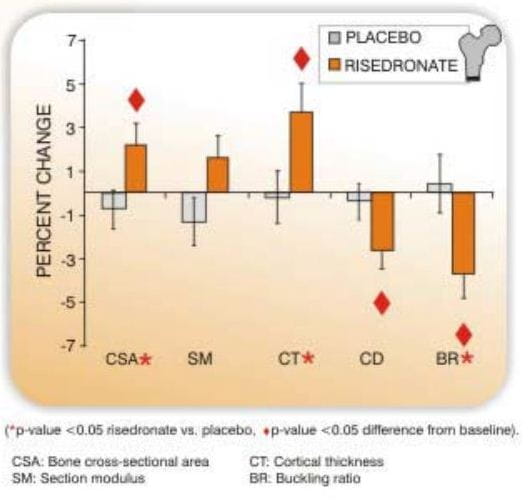
Except for SM (p=0.2293), all HAS parameters in the risedronate group significantly changed from baseline (p<0.05). Placebo group changes were not significant in any of these parameters.
Intertrochanter
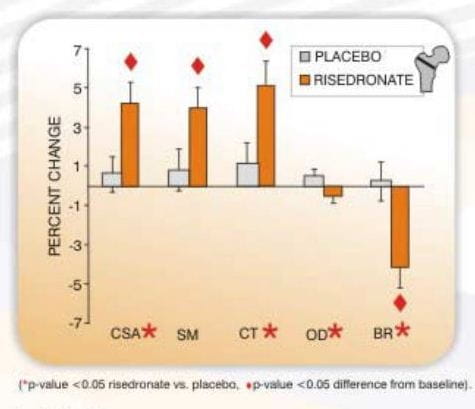
In risedronate group, after 1 year, the bone CSA, SM and CT increased by 4.25%, 3.97%. and 5.20%, respectively, while BR decreased by 4.18% (all p= 0.002 for change from baseline). In the placebo group, none of the above parameters showed a significant change.
After 1 year, BMD changed significantly in the risedronate group, while in the placebo group these changes were non-significant.
BMD

Adverse Events
Risedronate was well tolerated.
There were no significant differences of adverse events between the women in the placebo and risedronate groups.
Conclusion
Over 12 months, therapy with a once weekly risedronate. in women who become hypoestrogenic following adjuvant chemotherapy induced menopause, improves hip structural geometry in addition to the observed beneficial effects on BMD.
Reference
Bone 2008; 43: 274-278


