Effect of Application of Combination Serum Containing Vitamin C, Vitamin E, and Ferulic acid on Lentigine and Melasma after QSNL Laser Treatment

Introduction
Melasma is another facial hyperpigmentation type presenting with grey-brown reticular patches on the cheeks and periorbital area, which are more common in women and Asian skin. 1064-nm Q-switched Nd: YAG (QSNY) lasers have become an essential and common treatment for skin pigment changes. Among the various substances that have the potential to prevent the deleterious effects of environmental aging after laser treatment, antioxidants are the most effective and well-studied. a combination of l-ascorbic acid as an active isoform vitamin C, vitamin E, and ferulic acid has been shown in both in vitro and in vivo studies to prevent photoaging as well as increase wound healing and reduce post-treatment erythema and edema in patients who have undergone ablative fractional laser (AFL).
Aim
To evaluate the effect of this combination serum containing vitamin C, vitamin E, and ferulic acid on lentigine and melasma after QSNL laser treatment.
Patient Profile
- Patients with facial lentigine and melasma
Methods
- A prospective, randomized, split-face, controlled study
- N=18
- Patients were treated with a combination antioxidant serum on one randomized side of their face immediately after QSNY laser and twice daily for two weeks.
Intervention
- The patients were treated with a 1064-nm QSNY laser
- Immediately after the laser treatment, all patients were instructed to apply approximately 3-4 drops of a combination serum containing vitamin C, vitamin E, and ferulic acid on the side of the face randomized to receive application
- Patients were directed to apply topical moisturizer and physical sunscreen to both sides of the face during the study
Assessments
Patients were evaluated using digital photography and spectrometry to assess the melanin index and erythema index. Melasma severity score and global improvement scores also were assessed
- Melasma severity scale
- None= 0 Melasma lesions almost equivalent to surrounding normal skin or with minimal residual pigmentation
- Mild 1 =Slightly darker than surrounding normal skin
- Moderate 2 =Moderately darker than surrounding normal skin
- Severe 3= Markedly darker than surrounding normal skin
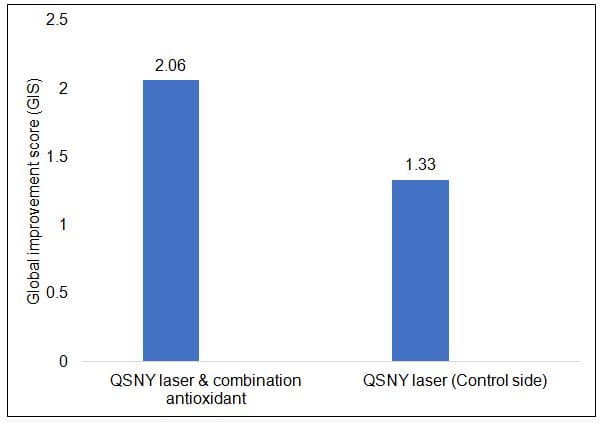
- Global improvement scoring system
- grade 0 = worsened
- grade 1= 0%-25% = minimal improvement or steady state
- grade 2=26%-50% = moderate improvement
- grade 3= 51%-75% = marked improvement
- grade 4= more than 75% = near total improvement
Results
Melanin and erythema index
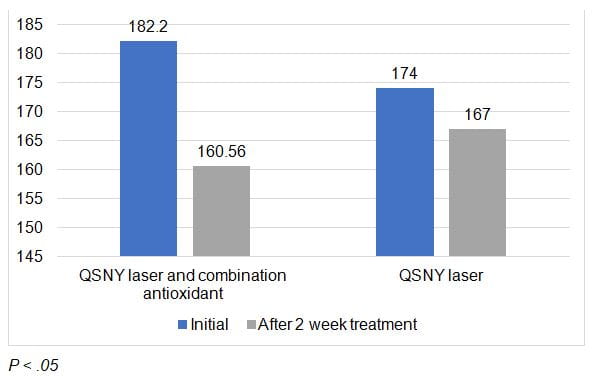
- A significant reduction (t-test, P < .05, Figure 4) in the melanin index on the combination antioxidant-treated side after 2 weeks compared with the non-treated side
- Both the combination antioxidant-treated and non-treated sides showed a reduction in erythema index
- Combination antioxidant-treated
- Baseline: 252.8 ± 57.38
- Post 2 weeks: 246.36 ± 35.51
- Non-treated sides
- Baseline: 267.30 ± 56.59
- Post 2 weeks: 253.63 ± 58.29
- Combination antioxidant-treated
Melasma severity score and clinical improvement of skin pigmentation
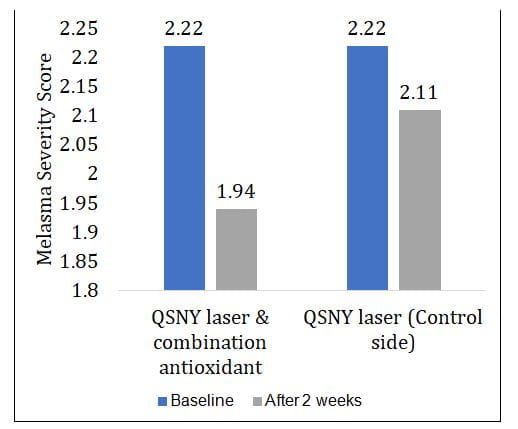
- The mean MSS score was significantly improved on the combination antioxidant-treated side compared with the non-treated side (Table 2).
- Moderate improvement was observed on the combination antioxidant-treated side, and a minimal to moderate improvement was observed on the non-treated side, which showed significant improvement in the anti-oxidant-applied group (Mann-Whitney U test, P < .05)
Safety assessment
- No adverse events occurred. No patients dropped out of the study due to side effects
Conclusion
- The use of a topical antioxidant immediately after laser treatment is safe and well-tolerated
- Adjuvant skincare treatments using antioxidants may further improve the effectiveness of clinical procedures, such as lasers
- The topical application of a combination vitamins C, E, and ferulic acid antioxidant formula may be a promising candidate to treat photoaging
Reference
J Cosmet Dermatol. 2020; 00:1–7