

Association Between Anaesthesia Depth and POCD Incidence at 7 days and 3 months Following Abdominal Surgery in Elderly Patients


Introduction
Postoperative cognitive dysfunction (POCD) is a common clinical complication that is associated with longer hospital admissions, increased mortality, and decreased longer term quality of life. It affects up to 16%–40% of middle?aged and elderly patients at 7 days after surgery and 10%–13% of elderly patients at 3 months or longer after surgery
Aim
To evaluate the association between depth of anaesthesia and POCD in elderly patients undergoing abdominal surgery
Patient Profile
Patients aged 60 years or older who were planned for abdominal surgery under total intravenous anaesthesia
Methods
- Randomized parallel controlled clinical trial
- 120 patients all 60 years or older patients scheduled to undergo abdominal surgery were randomly divided into two groups:
- Deep group (deep anaesthesia group with Bispectral Index (BIS), target 30–45) (n = 60)
- Light group (light anaesthesia group with BIS target 45–60) (n = 60)
- All study participants completed a battery of nine neuropsychological tests before surgery and at 7 days and 3 months after surgery
- POCD was calculated by using the reliable change index
- Plasma concentration of C?reactive protein (CRP), interleukin (IL)?1?, IL?10, S?100?, and norepinephrine (NE) were measured.
Results
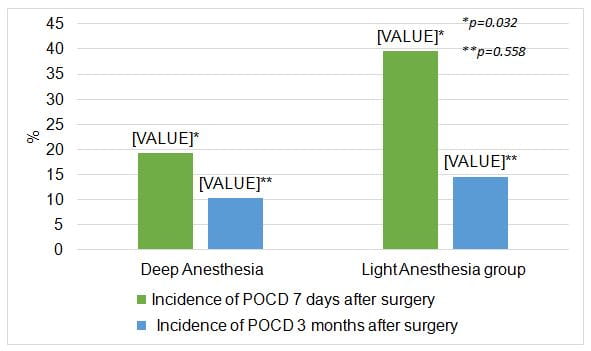
- The incidence of POCD at 7 days after surgery in the deep anaesthesia group was significantly lower than the light anaesthesia group (figure 1)
- The depth of anaesthesia had no effect on POCD at 3 months after surgery
- Plasma CRP and IL?1? levels were decreased in the Deep versus Light groups at 7 days post surgery
- No significant differences between groups at the 3?month follow?up
- No significant differences in the plasma concentration of IL?10, S?100?, and NE between the groups (p > 0.05)
|
Characteristics |
Deep group |
Light group |
|
Hospital stay (day) |
20±5 |
18±5 |
|
Complications |
|
|
|
First 7 days after surgery |
|
|
|
Pulmonary infection |
7 |
8 |
|
Incision infection |
3 |
2 |
|
Postoperative bleeding |
2 |
0 |
|
Cricoarytenoid joint |
0 |
2 |
|
Dislocation |
|
|
|
ARDS |
1 |
0 |
|
Intraoperative |
0 |
1 |
|
awareness |
|
|
|
Pain (opioid need cases) |
7 (2) |
9 (4) |
|
PONV |
6 |
7 |
|
Death |
1 |
0 |
|
3 months after surgery |
|
|
|
Incision infection |
2 |
2 |
|
Pain (opioid need cases) |
2 (0) |
3 (0) |
|
Rehospitalization |
4 |
5 |
|
Death |
1 |
1 |
Conclusion
The study demonstrated that deep anaesthesia under total intravenous anaesthesia was associated with a reduced incidence of short?term POCD and decreased release of inflammatory cytokines in elderly patients undergoing abdominal surgery compared with light anaesthesia
Reference
Brain and Behavior. 2019;9:e01238