

A Systematic Literature Analysis on Prevalence of Small Airways Disease in Adult Asthmatic Patients


Introduction
The small airways constitute an internal diameter smaller than 2 mm, and possess a small airway conducting zone and an acinar zone. Forced expiratory volume in 1 s (FEV1) and peak expiratory flow (PEF) are the conventional methods of assessing airways function but are not reliable and sensitive to record presence of small airways obstruction as they are influenced by the degree of airway resistance. Distinct physiological and imaging techniques used currently allow an assessment of the ‘quiet zone’, demonstrating that small airways disease (SAD) that contributes significantly to the clinical impact of asthma.
Methods
A systematic literature review was conducted using PubMed and only data reporting the prevalence of small airways disease were assessed. The search was conducted to determine the prevalence of SAD in adult asthmatic patients, and to discover SAD prevalence compared between different studies when measured using different methods of assessment on small airways.
Results
Out of 837, fifteen publications were identified for determining the prevalence of SAD in asthma. The overall prevalence of small airways disease were recorded from these studies that involved different inclusion characteristics and recruited patients with a broad range of asthma severity. The collective prevalence was reported to be 50-60%. Different methods used for assessment of prevalence were (Table 1):
- Prevalence using spirometry, plethysmography or volume assessments
- Prevalence using impulse oscillometry
- Prevalence using nitrogen washout
- Prevalence using HRCT
The presence of one or more of the parameters listed in Table 1 defined presence of SAD, and it was reported in 115 (52%) of these patients. The incidence of individual SAD studies is summarized in figure 1.
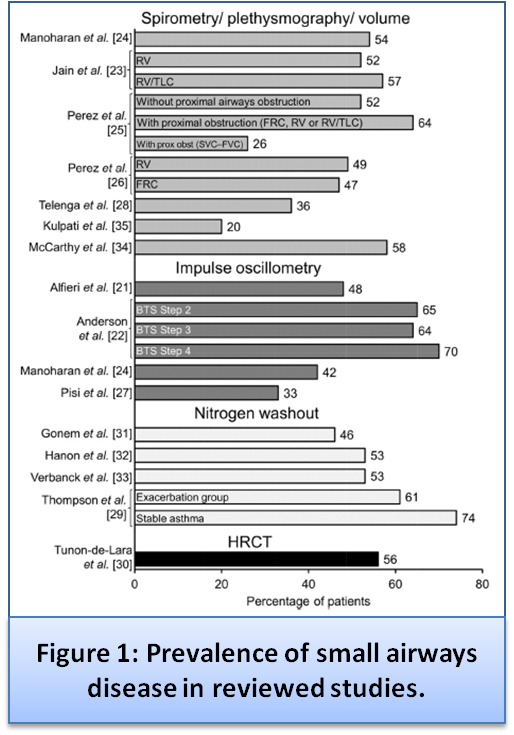
SAD assessed using spirometry, plethysmography or volume ranged from 20 – 64%. Prevalence of SAD using impulse oscillometry was between 33 – 70%. According to multiple-breath nitrogen washout, the prevalence of SAD ranged from 46 – 74%. The prevalence of SAD according to HRCT was 56%.
The study findings highlight the potential benefits of determining the presence of SAD despite the challenges encountered in measurement of SAD thus enabling appropriate targeting of pharmacotherapy.
Small airways disease was observed across all adult patients with asthma severities, with evidence of distal airway disease even in the absence of proximal airway obstruction.
Conclusion
The above study demonstrated prevalence of SAD in asthma patients is between 50–60%, including patients with normal FEV1, and patients with little or no proximal airflow obstruction.
Adapted From
- Usmani OS, Singh D, Spinola M, Bizzi A, Barnes PJ. The prevalence of small airways disease in adult asthma: a systematic literature review. Respiratory medicine. 2016 Jul 1; 116:19-27.