




Pseudomonas aeruginosa (P aeruginosa) is a physiologically versatile pathogen found in multiple environments. In the last twenty years, pseudomonal infections have increased, particularly in immunocompromised patients. Drug resistance due to extended spectrum beta-lactamase (ESBL) production by P. aeruginosa has also been reported. The ESBL reservoir is found in P aeruginosa and is not restricted to the enterobacteriaceae family alone. However, in India, the occurrence and detection of ESBL-producing P. aeruginosa strains has been undefined. No method to detect ESBL-producing P. aeruginosa has been described by the Clinical Laboratory Standards Institute (CLSI) guidelines.
Pseudomonas: Incidence and Susceptibility in India

2 May, 11
Pseudomonas - Incidence and Susceptibility
Study 1
Background
Objective
To detect ESBL-producing P. aeruginosa isolates from various clinical samples and study their antibiotic sensitivity patterns.
Method
Clinical isolates of P. aeruginosa (n = 148) from various body fluids like blood, pus, urine, CSF, sputum and tracheostomy swabs were obtained from patients admitted at the Pt. B. D. Sharma Post Graduate Institute of Medical Sciences, Rohtak. Third-generation cephalosporin sensitivity of the isolates was determined by the disc diffusion method, using P. aeruginosa ATCC 27853 as the control strain. Results were interpreted according to the CLSI guidelines.
ESBL production in all the isolates was detected by the double disc synergy test as described by Jarlier. The antimicrobial susceptibility test of ESBL-producing P. aeruginosa was done by the disc diffusion method. Results were interpreted according to the CLSI guidelines.
Results
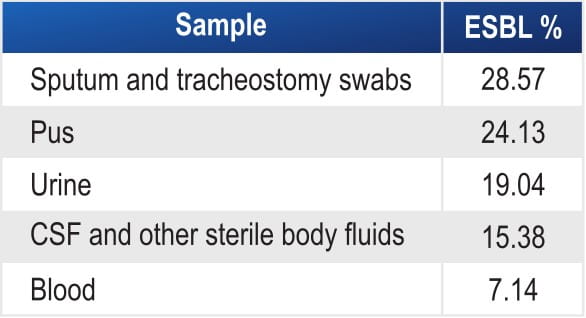
- 20.27% of the total P. aeruginosa isolates were ESBL producers.
- Maximum ESBL producers were found in the sputum and tracheostomy wound swabs.
Table 1: Distribution of ESBL-producing P. aeruginosa according to the clinical samples
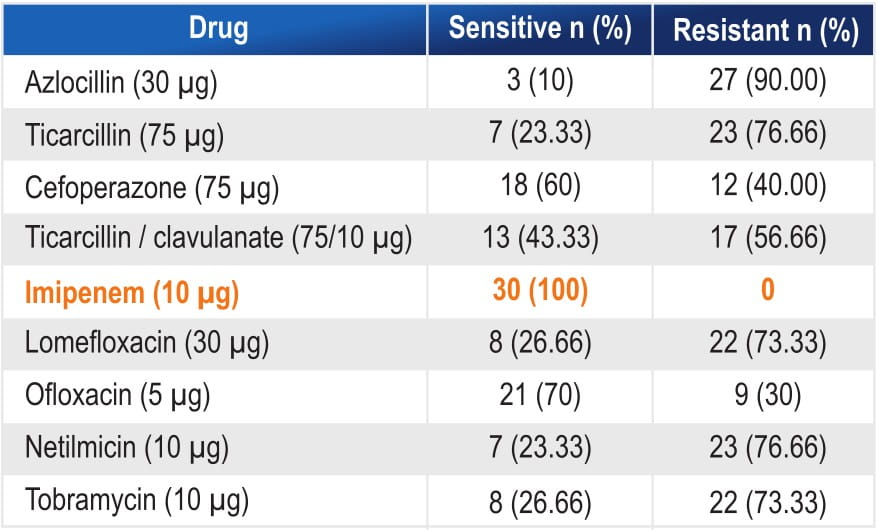
- All the ESBL-positive P. aeruginosa were multidrug-resistant.
- Isolates were 100% sensitive to imipenem and showed 70% sensitivity to ofloxacin.
Table 2: Antibiotic sensitivity pattern of ESBL-positive P. aeruginosa (n = 30)
Conclusion
- ESBL-producing bacteria show a MDR pattern, including the aminoglycoside and fluoroquinolone drug classes.
- Beta-lactam/beta-lactamase inhibitors should not be considered as first-line therapy for treating serious ESBL infections as there is limited clinical experience with the use of these agents.
- Imipenem was the only drug effective against ESBLs producers.
- Carbapenems are, thus, the treatment of choice for ESBL infections; however, indiscriminate use of these agents may promote increased resistance to carbapenems.
Indian J Pathol Microbiol 2008; 51: 222-4
Study 2
Background
An increase in ESBL-producing pathogens has been observed recently, leading to more usage of beta-lactamase inhibitors/beta-lactam combinations, monobactams and carbapenems. Carbapenems are the drug of choice for treating MDR gram-negative bacilli infections. Carbapenem resistance has been reported in a few bacteria, especially the Pseudomonas species (spp.). There is limited data on the prevalence of carbapenem resistance in clinical isolates in India.
Objective
To analyse the antimicrobial activity of meropenem and imipenem in gram-negative bacilli isolated from clinical specimens in North India.
Method
This was a retrospective study carried out at the All India Institute of Medical Sciences, New Delhi (AIIMS). Bacterial pathogens from body fluid samples (blood, urine, tracheal aspirates/bronchoalveolar lavage, soft tissue fluid) of patients were isolated and identified.
Organisms which showed intermediate antibiotic resistance were considered resistant organisms and analysed. Beta-lactamase-negative strains of E. coli and P. aeruginosa and ESBL-positive strains of Klebsiella pneumoniae (K. pneumoniae) were used as control organisms.
The gram-negative bacteria isolated from the clinical samples were tested for ESBL production by using ceftazidime, ceftazidime/clavulanic acid, cefotaxime, and cefotaxime/clavulanicacid discs and interpreted as per the NCCLS guidelines.
Meropenem and imipenem susceptibility patterns of all ESBL-positive bacteria were recorded.
Results
- Pseudomonas spp. and Acinetobacter spp. were the most common pathogens.
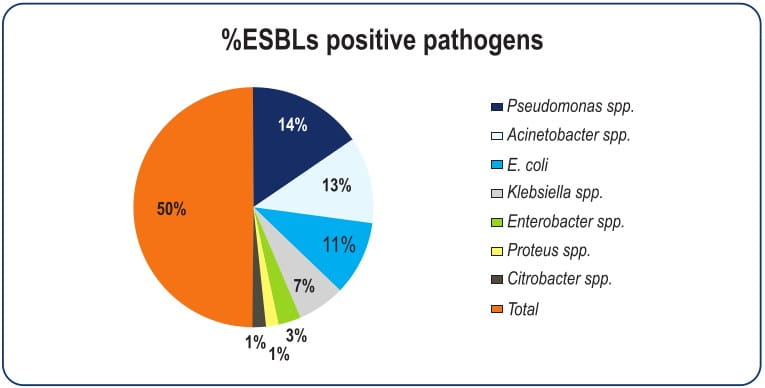
- 82.68% of the gram-negative isolates showed susceptibility to imipenem and 77.84% were susceptibile to meropenem.
- Overall, imipenem showed better activity than meropenem.
Conclusion
- Carbapenem resistance in gram-negative bacteria is increasing in India.
- Rational use of antimicrobials and strict adherence to the concept of "reserve drugs" in order to minimize the misuse of available antimicrobials is needed.
- Regular antimicrobial susceptibility surveillance is essential.
Indian J Med Res 2006; 124: 95-98
Study 3
Background
P. aeruginosa is a common gram-negative pathogen responsible for hospital- acquired infections and is difficult to treat due to its resistant drug profile. Carbapenems are used for the treatment of pseudomonal infections. However, non-fermenting pathogens like P. aeruginosa and Acinetobacter spp. have been showing resistance to carbapenems, mainly due to the production of metallo beta-lactamases (MBLs). Prevalence and the screening methods for MBLs are not well elaborated in India.
Objective
To detect the production of MBLs enzyme production in nosocomial isolates of P. aeruginosa
Method
This study was carried out at the Sri Ramachandra Medical College & Research Institute, Chennai. Altogether, fifty P. aeruginosa isolates from various specimens like urine, blood, respiratory specimen-BAL and exudates were collected.
Various methods have been recommended for screening MBLs. In this study, the production of MBLs was detected by two methods:
- Zone size enhancement with EDTA-impregnated imipenem and ceftazidime discs.
- A four-fold reduction in the MIC with the imipenem-EDTA combination
Results
- 84% of the isolates tested were susceptible to imipenem.
- 16% of the isolates were resistant to imipenem, of which 87.5% were MBLs producers.
Conclusion
- Imipenem resistance in P. aeruginosa by MBLs is a cause for concern in the therapy of ICU patients.
- Both methods used to detect the production of MBLs are equally effective confirmatory methods for the detection of MBLs-mediated imipenem resistance in P. aeruginosa.
Indian J Med Res 2005:122: 148-152
Study 4
Background
Ventilator-associated pneumonia (VAP) is the most common nosocomial infection seen in the ICU and is often associated with a high morbidity and mortality rate. P. aeruginosa, E. coli, K. pneumoniae, Acinetobacter spp. and Staphylococcus spp. are the most common antibiotic-resistant nosocomial pathogens causing VAP.
Objective
To determine the incidence, risk factors, outcome and causative pathogens of VAP in a cardiac surgical ICU.
Method
In this study, 952 adult patients undergoing cardiac operations were admitted to the ICU on intermittent positive-pressure ventilation. These patients were routinely administered stress ulcer prophylaxis and intravenous antibiotic prophylaxis. While 927 patients belonged to the non-VAP group, 25 were in the VAP patient group.
During the study, each patient's age, gender, IPPV hours, re-intubation, underlying illness, APACHE II score, type of surgery, redo operations, enteral nutrition, total ICU stay, steroid treatment, total postoperative stay, intra-aortic balloon counterpulsation (IABC) used, tracheostomy, and antibiotic usage were recorded.
Results
- Univariate analysis revealed that emergency surgery, COPD, tracheostomy, re-intubation, coma, steroid treatment, APACHE II score, number of antibiotics before VAP, IPPV and IABC, and enteral feedings were risk factors for VAP.
- Total ICU stay and total post-operative stay was significantly higher among VAP patients.
- 84% of the cases of pneumonia were due to Gram-negative organisms alone and 16% of the pneumonia cases were due to a combination of gram-positive and gram-negative pathogens.
- The most common pathogen isolated was P. aeruginosa (52.3%), followed by E. coli, K. pneumoniae, Acinetobacter spp. and Staphylococcus spp. Of these, P. aeruginosa is one of the most difficult to treat.
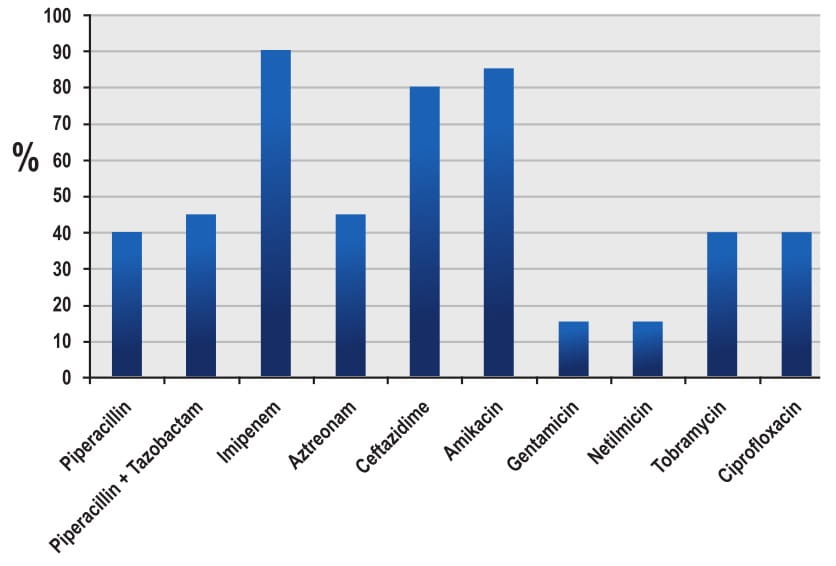
- Imipenem (91.89%) and amikacin (86.48%) showed the best activities against the gram -negative isolates.
Figure 1: Percentage of susceptible P. aeruginosa from the VAP cases
Conclusion
- The most common pathogen isolated was P. aeruginosa
- Imipenem showed the highest susceptibility against P. aeruginosa, followed by amikacin (Figure 1).
- Good management strategies for VAP such as adequate infection control practices, early and accurate diagnosis and more specific antimicrobial use may significantly improve patient outcomes.
J Cardiothorac Vase Anaesth., 2003; 17(1): 22-8.
Related Topics
More From Area Of Interest
You may also like

12 Oct, 26

21 Sep, 26
21 Sep, 26

21 Sep, 26

13 May, 26

17 Apr, 26
Latest Items

12 Oct, 26

12 Oct, 26
Journal Scans
8 Oct, 26

8 Oct, 26


