




Mycobacterium tuberculosis: Present in droplet nuclei of persons with pulmonary or laryngeal TB disease and transmitted through coughing, sneezing, singing and shouting.
Nutshell Series 2: Tuberculosis Infection and Disease

21 Sep, 10
Nutshell Series 2: Tuberculosis Infection and Disease
Causative Organism
Clinical Manifestations
Among HIV-infected persons, the presentation of active TB disease is influenced by the degree of immunodeficiency.
In HIV-infected patients without pronounced immunodeficiency (e.g., CD4+ count >350 cells/?L), HIV-related TB clinically resembles TB among HIV-uninfected persons. The majority of patients have disease limited to the lungs, and common chest radiographic manifestations include upper lobe fibronodular infiltrates with or without cavitation. Extrapulmonary disease is more common in HIV-infected persons than in HIV-uninfected persons, regardless of CD4+ counts.
In advanced HIV disease, the chest radiographic findings of pulmonary TB are markedly different compared with those among patients with less severe immunosuppression. Lower lobe, middle lobe, interstitial, and miliary infiltrates are common and cavitation is less common. Marked mediastinal lymphadenopathy also can be found.
With increasing degrees of immunodeficiency, extrapulmonary TB (e.g., lymphadenitis, pleuritis, pericarditis, and meningitis), with or without pulmonary involvement, is more common, and found in the majority of TB patients with CD4+ counts <200cells/?L.
In severely immunodeficient patients with a high mycobacterial load, TB disease may be subclinical or oligo-symptomatic. After initiation of antiretroviral therapy (ART), immune reconstitution might unmask active TB, resulting in pronounced inflammatory reactions at the sites of infection.
Diagnosis
Pulmonary Tuberculosis (PTB)4
- Sputum smear microscopy
- Chest X-ray
- Sputum culture
The most important symptoms in the diagnosis of PTB are the following:
- cough for more than 2 or 3 weeks;
- sputum production;
- weight loss.
Other symptoms
Respiratory: chest pain, haemoptysis, breathlessness.
Constitutional: fever, night sweats, tiredness, loss of appetite, secondary amenorrhoea. Weight loss and fever are more common in HIV-positive PTB patients than in those who are HIV-negative.
Extrapulmonary Tuberculosis (EPTB)4
The common forms of extrapulmonary TB associated with HIV are the following: lymphadenopathy, pleural effusion, pericardial disease, miliary TB, and meningitis. Many patients with extrapulmonary TB also have coexistent pulmonary TB.
If a patient has extrapulmonary TB, pulmonary TB should be looked for. If the patient has had a productive cough for more than 2 or 3 weeks, sputum samples should be sent for Acid Fast Bacilli (AKB) testing. If AFB testing is negative, do a chest X-Ray(CXR).
Definitive diagnosis of EPTB is often difficult. Diagnosis may be presumptive, provided you can exclude other conditions. Patients usually present with constitutional features (fever, night sweats, weight loss) and local features related to the site of disease.
Preventive Therapy
Co-Trimoxazole Preventive Therapy5
WHO (2009) recommends that in all HIV-positive TB patients, co-trimoxazole preventive therapy should be initiated as soon as possible and given throughout TB treatment. Co-trimoxazole preventive therapy substantially reduces mortality in HIV-positive TB patients.
Isoniazid Preventive Therapy6
WHO (2010) also recommends that individuals living with HIV who do not have active TB should be offered isoniazid preventive therapy (IPT). IPT should be given for at least 6 months. Also strongly recommend at least 6 months of IPT for children and adults including pregnant women, people living with HIV and those receiving ART, and those who have successfully completed TB treatment. IPT for a duration of 36 months is conditionally recommended in settings with a high transmission of TB among people living with HIV.
Drug Therapy for HIV/TB Co-Infection
The first priority for HIV-positive TB patients is to initiate TB treatment, followed by co-trimoxazole and ART. The WHO2,6 and HIV Medical Association of India (HIVMAI)3 guidelines recommend that all patients with TB should be offered an HIV test with pre-test counseling. This is essential as the management of TB differs amongst HIV-infected patients as compared to HIV-negative patients and TB is an indication to initiate ART irrespective of CD4 counts.
Managing TB Amongst HIV-Infected Patients3
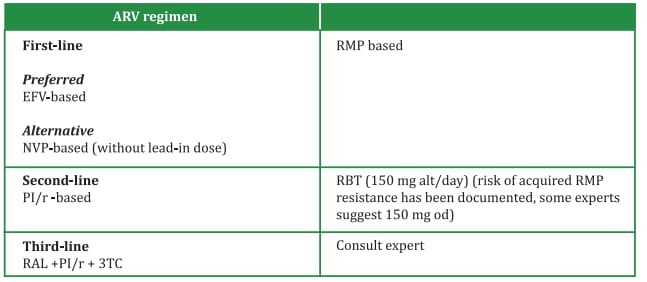
- A rifampicin (RMP)/rifabutin (RBT) based regimen is necessary throughout the duration of anti-TB treatment as it has better outcomes (failure and relapse) apart from shortening the duration of TB treatment.
- Ethambutol should be included in the maintenance phase as the prevalence of primary isoniazid (INH) resistance is high in India.
- Daily treatment (rather than intermittent) throughout the course of TB treatment is more effective in preventing treatment failure and relapse rates.
- A consideration may be given to extend the duration of TB treatment to at least 8-9 months as that has been associated with better outcomes, however at least 6 months of RMP-based regimen is recommended. Ideally an anti-TB drug susceptibility testing is necessary prior to initiating anti-TB treatment especially amongst re-treatment patients.
When To Start ART?
ART improves survival in HIV-positive patients. In addition, ART reduces TB rates by upto 90% at an individual level, by 60% at a population level and it reduces TB recurrence rates by 50%.
WHO recommends initiation of ART in all HIV-infected individuals with active TB, irrespective of the CD4 cell count. TB treatment should be started first, followed by ART as soon as possible afterwards (and within the first eight weeks).2
The HIVMAI guidelines recommend that for patients with CD4<50/mm3 ART should be initiated around 2 weeks of starting anti-TB treatment. For patients with CD4>50/mm3, ART may be delayed until 8 weeks of anti-TB treatment.3
What ART to Start?
WHO Recommendations for First-line ART Therapy2
The recommended first-line ART regimens for TB patients are those that contain EFV since interactions with anti-TB drugs are minimal. However, because of concerns related to teratogenicity, EFV should not be used in women of child-bearing potential without adequate contraception, nor should it be used for women who are in the first trimester of pregnancy.
- AZT or TDF + 3TC (or FTC) + EFV
WHO Recommendations for Second-line therapy2
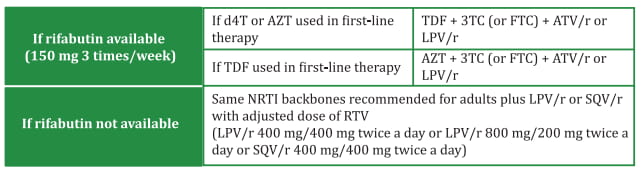
HIVMAI Recommendations of ARVs/anti-TB drugs3
When TB is Diagnosed in People Living with HIV who are Already on ART5
When TB is diagnosed in patients already receiving ART, TB treatment should be started irr lmediately. Th ere are two issues tc ) consider in such cases:
- whether ART needs to be modified because of drug-drug interactions or to reduce the potential for overlapping toxicities,
- whether the presentation of active TB in a patient on ART constitutes ART failure that requires a change in the ART regimen.
Adverse Events
IRIS (Immune reconstitution inflammatory syndrome) or a paradoxical reaction occurring after the initiation of ART is thought to be the result of recovery of immune responses to previously recognized TB antigens, reconstituted by ART or by TB treatment itself.1
- It is more common when CD4 count is low (<50 cells/mm3).
- Usually occurs in the first 1- -3 months after starting ART in patients receiving TB treatment.
- Can include high fevers, worsening respiratory status, increase in size and inflammation of involved lymph nodes or new lymphadenopathy, breakthrough meningitis or new or expanding CNS lesions, radiologic worsening of pulmonary parenchymal infiltrations, and increasing pleural effusions.
- Most cases resolve without intervention and ART can be safely continued.
Gastrointestinal reactions are common with many of the anti-TB medications and may be managed without discontinuing TB medications; either change the hour of administration or administer drugs with food.
Skin rashes are common with all of the anti-TB drugs.
- If rash is minor, affects a limited area, or causes pruritis, antihistamines should be administered for symptomatic relief and all anti-TB medications continued.
- If the rash is severe, all TB medications should be stopped until the rash is substantially improved, and TB drugs restarted one by one at intervals of 2-3 days.
Fever in an HIV-infected patient who has been receiving effective TB therapy for several weeks might represent drug fever, a paradoxical reaction, or IRIS.
Drug-induced liver injury can be caused by INH, rifamycins, or pyrazinamide and is defined as an AST elevation; disproportionate increases in bilirubin and alkaline phosphatase also occur occasionally.
References
1) CDC Guidelines for Prevention and Treatment of Opportunistic Infections in HIV-infected Adults and Adolescents. MMWR 2009;58(No RR-4):19-28
2) Antiretroviral therapy for HIV infection in adults and adolescents: recommendations for a public health approach. WHO 2010
3] Antiretroviral therapy, Evidence-based Treatment Options in 2011; HIV Medical Association of India 2011
4) TB/HIV: Clinical Manual, 2nd Edition; WHO 2004
5) Treatment of tuberculosis: guidelines - 4th ed; WHO 2009
6) Guidelines for intensified tuberculosis case finding and isoniazid preventive therapy for people living with HIV in resource constrained settings.WHO 2010
7) Global tuberculosis control: WHO report 2011
Related Topics
More From Area Of Interest
You may also like
21 Sep, 26
21 Sep, 26
21 Sep, 26
13 May, 26
17 Apr, 26
Our Research
23 Feb, 26
23 Feb, 26
Latest Items
Journal Scans
8 Oct, 26
8 Oct, 26
Journal Scans
7 Oct, 26

7 Oct, 26
Journal Scans
5 Oct, 26
5 Oct, 26


